I don’t know about you, but for me, the world right now is a lot.
Amidst the tragedy and uncertainty, one thing that hits me is that the world is becoming more divided. Putting up walls, cooperating a bit less. That isn’t just on the world stage; I see it in client organisations as well from Senior Leadership through to management teams. People are becoming insular, working in silos, going with what and whom they know rather than valuing difference.
In January, at Davos, Mark Carney warned:
“A world of fortresses will be poorer, more fragile and less sustainable.”
Senior Leaders and Managers Building Communities and Communication
One of the most frequent requests we get is to work with organisations to “break down silos” and increase collaboration. But how do we do that, especially when the direction of travel can seem away from that? Fear and uncertainty can be the bricks that form fortresses.
In March, we hosted a breakfast event to celebrate B-Corp month and discuss how we build a culture of community within our own organisations and beyond.
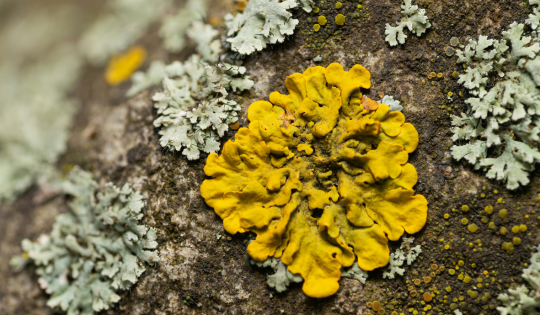
Our Head of Client Development and Marketing, Kitty, loves lichen because they’re biological overachievers. A lichen isn’t one thing; it’s an algae and a fungus working as a single organism. It thrives in places—even outer space—where single species would just give up and die.
This isn’t just a “nice to have” biology lesson. It’s the core of the B-Corp Declaration of Interdependence.
As a B Corp, we believe that we all depend on one another. We have to conduct business as if people, places, and diversity actually matter, because, commercially speaking, that is the only way to survive and thrive.
So, we hit upon…
Lichen- omics!*
*with a big hat tip to Rohit Bhargava
Using our little green (sometimes) symbiotes as a guide, we hit on three principles for creating community. We asked the senior leaders and managers at the breakfast to expand on how we can live and communicate those principles in our organisations.
Somewhere to Grow: Psychological Safety as a Community Performance Tool
You can’t expect a team to innovate if they’re spending all their cognitive energy feeling “on trial.” Creating “somewhere to grow” isn’t about forced socialising; it’s about trust and psychological safety.
Based on the contributions from our attendees, here is how we build that foundation:
- The Trust Loop: We must give trust to receive trust. That means leaders giving people chances and allowing risks.
- Permission to be Human: We need to allow and recognise that we all make mistakes.
- Accessibility over Hierarchy: Ensure everyone knows who to ask for help (ideally, that will be everyone in the room).
- Practical Support: This means maintaining investment in mental health first aid, employee wellbeing, and physical proximity.
Different Species: Leveraging the “Algae and Fungi”
Lichens work because two separate organisms lean on each other’s radical differences. In your office, that means moving away from demanding uniform thinking and leaning into diverse ideas.
Our audience identified key ways to support these “different species”:
- Presume Good Intent: Start from a place of curiosity rather than judgment.
- Radical Inclusion: Make the effort to include others, learn people’s names, and bridge age gaps.
- Healthy Discomfort: Encourage people to step outside their comfort zones and ask the hard questions.
Shared Goal: Communicating Purpose for Leaders and Managers
Synergy is a buzzy word (in fact, my grammar checker told me not to use it). Still, in Lichen-omics, it’s a survival strategy. When the algae and fungus combine, the result is a mutual understanding of what the organisation is there for, rather than just what it does. A shared sense of purpose well communicated through leaders, managers and teams simplifies your decision-making. The answers become clear.
Our audience said that meant creating:
- Real-World Goals: Setting simple, realistic goals that everyone can get behind.
- Active Community: Purpose isn’t static; it’s built through shared personal values and being involved in conversations. This means creating opportunities for people to act as a group and share what the purpose and mission of the company mean for them.
- Curiosity as Fuel: Curiosity doesn’t just solve problems; it energises the team towards the goal. Senior leaders and managers can see questions about the organisation’s strategy not as a challenge but as an opportunity to build engagement.
Finally, our audience left asking these questions of themselves and their organisations:
- Are we living our values every day? Do our leadership and management practices reflect the belief that “people matter,” or are we just focused on the bottom line?
- How are we handling conflict? Are we catching people doing things right and asking, “What does support look like?” or are we leading through fear and compliance?
- Are we communicating well? Or are we assuming people just work on a need-to-know basis and learn by osmosis and assumption?
- Are we acting like an ecosystem? How are we actively drawing out diverse ideas to ensure we aren’t just a fragile fortress?
Thank you to everyone who came to our breakfast event and to the brilliant B-Corp community we are so proud to be part of.
Let’s stop bricking it, like fortresses and start thriving like lichen.
References:
Mark Carney – Davos
“A world of fortresses will be poorer, more fragile and less sustainable.”
B Corp declaration:
B-Corp Declaration of Interdependence.
https://bcorporation.uk/b-corp-certification/what-is-a-b-corp/
Likeonomics:
