As fires rage and looting runs on around the country it’s timely to remember that far less than 1% of young people are involved so over 99% are peaceful and many are a positive influence on the world.
So I’m doubly proud to post my daughter’s blog on her experience in Manvi, Southern India where she was working with the Dalit community (the Untouchables) for the past month. These are people who truly have nothing and their young people are disadvantaged in a way most in this country couldn’t begin to imagine.
The young people on this trip and many thousands like them are living their personal brand and showing leadership qualities from an early age. Something to remember as we watch those scenes of violence around the UK.
Here’s what Guenna has to say:
We arrived at Loyola School, Manvi on 10th July 2011; it was the start of our month with the school. After setting up in our room, which I shared with seven other girls, we went out to greet the children. The excitement of new visitors from London soon meant that we were surrounded by hundreds of children of all ages, asking our names and making friendship signs with us. As it was my second year at the school, I was greeted by some of the children that I had met the year before, they were very happy that I had come back as so many of the people who visit the school do not have that opportunity.
Very quickly we came to our first work day in India. My group was sent to a small village, about half an hour from the school, called Pannur to work. Each morning we spent four hours carrying cement blocks from large piles, filled with scorpions and rats, and stacking them by the walls of what was soon to be the nursery. The work was hard and after the first morning we all spent the afternoon in our beds trying to recover some energy for the evening.
That evening I went to the health centre to visit the nuns who work there. They were very friendly and told me about the amazing work they were doing in Pannur and the surrounding villages. As well as giving out medicines, they worked to set up women’s societies to empower the women in the villages and stand up against oppression and injustice. Over the three days that I spent in Pannur I visited two other villages with the sisters and was amazed by the way they communicated their ideas and hopes with the villagers.
Going round the villages and visiting the families greatly widened my conceptions of rural India. The villagers were always very welcoming and asked me to enter their houses and share their food. Accepting a meal from a low caste family in India is very symbolic, as high caste villagers do not eat the same food as low caste villagers. So when I agreed to eat a meal with them I treated them as equals, which they are not used to. The houses in the villages show you the poverty in which these people live. Most of them are mud huts with one room to house eight or more family members; despite this the villagers have a lot of pride in their modest houses.
Visiting the villages where the children from Loyola school come from showed me the importance of our work with the children. I spent the rest of the month trying to give the children as much attention and acceptance as possible. We worked on building the teachers hostel each morning, rested until four and then went out to visit the children until eight when we all went in for our dinner. Each morning I thought I was too tired to move but by four the thought of the chance to spend time with the children was enough to get out of bed and make my way to the children’s hostel.
I shared many experiences with the children over the month, I helped them make chapattis, had my henna done, studied with them, celebrated mass with them and played cricket with them. Each moment I spent with them strengthened our relationship, and I hope I gave them more confidence in themselves, and inspired them to aim high and try to reach their goals. I believe that although our time spent building is a great help to the school, the greater service that we provide is the attention that we give to the children. With over four hundred children in one hostel with only a handful of adults to look after them, they are starved for the attention that every child needs.
As our stay came to an end, the whole school was busily preparing for the St Ignatius feast day. As the school is a Jesuit school, this feast day is one of the most important of the year. Families come from miles away to see their children performing in the function that the school takes months to prepare. For those days we stopped work on the teachers’ hostel and spent our time filling in the stage for the function instead. There were dance rehearsals for the whole school including us as we were performing a traditional Indian dance. The children spend months practicing for the feast day and if their dance isn’t found to be up to a high enough standard then it is removed from the program, so all the children were very excited and nervous.
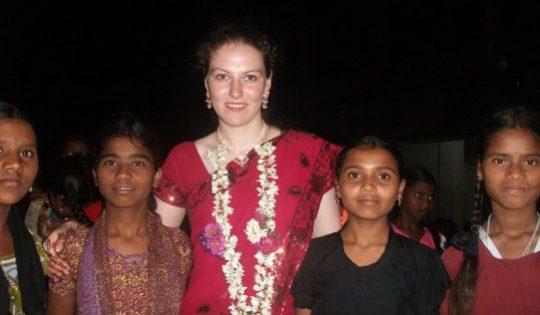
On the day of the feast day, we woke early and our dance teachers came to help us put on our saris and do our hair. We then made our way to the Pre-University College where the mass was about to start. The whole school took part in the service and the families started to arrive. After mass the program started. We were amazed to see all the children we had spent the month with, dressed in beautiful costumes and performing exceptional dances. When it came to our turn we were all very nervous, however we performed our dance to the crowd of roughly three thousand without any problems and were all very relieved.
After the function many of the children took us to be introduced to their family. I was very humbled by how much respect each family gave to me and will never forget the delight that they had from my knowing their children.
All too soon it was time to leave the school and return to Bangalore on the ten hour sleeper train. The children from the hostel came down to see us off. It was very emotional and many of the children tried to make us stay. Finally, the bus pulled out of the school campus with the children running and waving after us. It was the end of our India experience and time to go home.

Leave a comment